
Topological Data Analysis: Detecting Structural Threats Before They Become Events
In contested environments, failure rarely begins as an event.
It begins as a structural shift.
Communication networks reorganize.
Information flows tighten or fragment.
Logistics pathways subtly rewire.
Biological spread patterns deviate from natural diffusion.
Adversarial coordination geometry changes before kinetic action.
By the time conventional indicators spike, the topology of the system has already transformed. Most analytic pipelines are optimized for classification, regression, or prediction. They are not optimized for structural detection. But that distinction is operationally decisive.
The Operational Problem: High-Dimensional Systems Under Stress
Modern defense and intelligence systems generate data streams that are:
Nonlinear
High-dimensional
Distributed
Adversarially perturbed
Temporally unstable
Traditional models assume a relatively stable feature space. Even advanced machine learning systems often function as powerful curve-fitters: they map input to output without interrogating the geometry of the system itself.
But adversaries do not operate linearly. And complex systems do not degrade linearly. Instead, they undergo phase transitions. In those transitions, the shape of relational interaction shifts before scalar metrics move beyond thresholds.
This is where Topological Data Analysis (TDA) becomes strategically relevant.
From Variables to Geometry
Rather than modeling variables independently, TDA constructs a relational geometry of the system:
Nodes become points in a high-dimensional space.
Similarities are defined by proximity.
Proximity generates simplicial structures.
Multi-scale structure reveals persistent features.
The key shift is conceptual. Instead of interrogating variables, we interrogate structure.
In operational contexts, structure encodes:
Coordination
Fragmentation
Redundancy
Emergent hierarchy
Latent instability
And when structure reorganizes, it often signals regime change.
What Is Persistent Homology?
Imagine you are watching a swarm of drones from above. At first, they appear scattered - small clusters, loose groupings. Now imagine gradually increasing a “connection radius” between them:
At very small radius, only immediate neighbors connect.
As the radius grows, clusters merge.
Eventually, loops form - encirclements, coordinated rings.
At larger scales, those loops fill in and disappear.
Persistent homology tracks:
Connected components (fragmentation or consolidation)
Loops (encirclement, coordination cycles, feedback structures)
Voids (higher-order structural gaps)
Crucially, it measures which features:
Appear briefly (noise)
Persist across multiple scales (structure)
You can think of it as turning a complex dataset into a “barcode” of structural signatures.
Short bars = transient artifacts.
Long bars = persistent structure.
In dynamic systems, changes in those structural barcodes often precede visible instability.
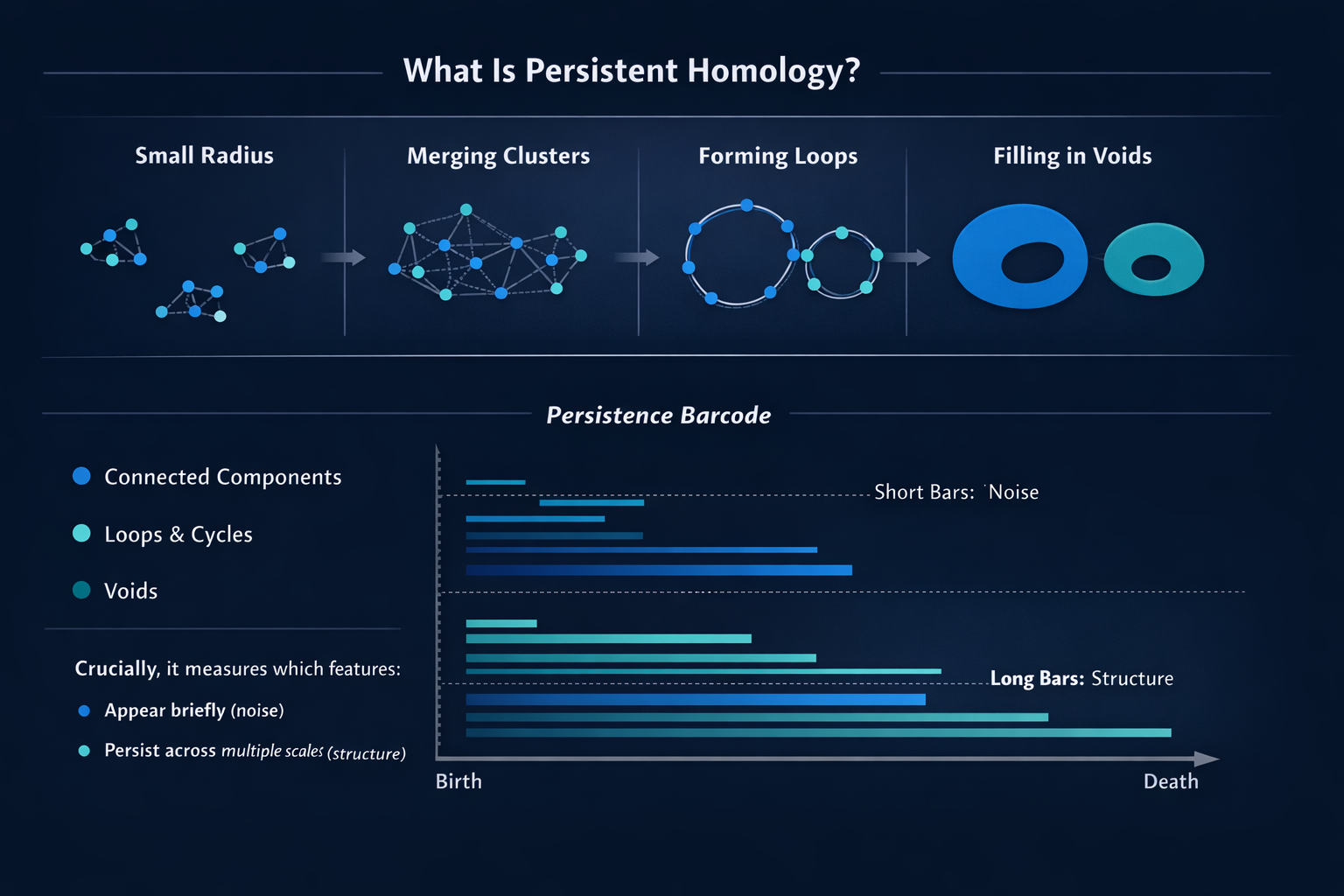
Diagram of persistent homology.
Why This Matters for Defense Applications
In contested domains, adversaries adapt structurally. Consider scenarios:
A cyber intrusion campaign reorganizing lateral movement.
A synthetic biological release deviating from natural epidemiological patterns.
Influence networks polarizing into rigid echo chambers.
Maritime traffic reorganizing under covert coordination.
Supply chain networks shifting toward hidden redundancy patterns.
These do not begin as obvious anomalies, but as geometric reorganizations.
Conventional anomaly detection looks for deviation in scalar variables. Topological analysis detects deviation in relational structure. That difference can mean the difference between reactive and anticipatory posture.
Operational Integration Beyond Visualization
Topological methods are sometimes misrepresented as exotic visualization tools. However, that is a misunderstanding. When properly integrated, TDA can be embedded within:
Streaming anomaly detection systems.
Multi-modal intelligence fusion pipelines.
Cyber-physical monitoring frameworks.
Swarm coordination analysis.
Early-warning systems for systemic instability.
But the strategic value does not lie in computing persistent homology alone.
It lies in:
Constructing the correct relational representation.
Embedding temporal windows without inducing artifacts.
Distinguishing structural signal from sampling bias.
Translating topological signatures into actionable thresholds.
Structural Detection as Strategic Advantage
Modern defense strategy increasingly depends on anticipating system-level instability rather than responding to discrete events. In that environment, the analytic question shifts from:
What is happening?
to:
Is the structure of the system changing in a way that indicates escalation, coordination, or phase transition?
Topology offers a mathematically rigorous way to answer that question. When integrated properly, it can reveal:
Early-warning signals
Hidden coordination
Systemic fragility
Emergent organization
Adversarial adaptation
If your organization operates in high-dimensional, nonlinear, or adversarial environments - and you suspect traditional analytics may be insufficient for detecting structural transition - it may be time to consider a topological framework.
DataField Intelligence develops advanced structural analytics tailored to operational defense and national security contexts. Our methodologies integrate topological techniques within mission-specific analytic pipelines - without sacrificing interpretability or deployability.
To explore how structural analysis could enhance your anomaly detection, coordination assessment, or systemic risk monitoring capabilities:
Request a technical consultation with DataField Intelligence.
In complex systems, the earliest signal of threat is rarely a spike.
It is a change in shape.